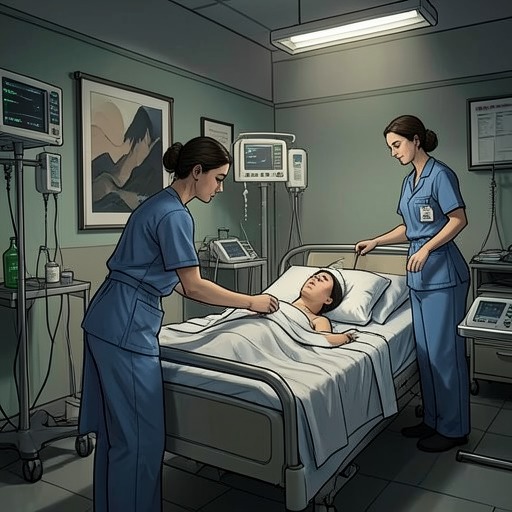
Nurse Mayinga N.
The Hot ZoneNurse Mayinga N. was a young nurse at Ngaliema Hospital in Kinshasa whose illness became the focus of an international emergency in 1976. After caring for Sister M.E., she developed symptoms and, for two days, moved between government offices and hospitals while the infection’s cause remained unknown. Her death triggered precautions in Kinshasa and concern that the virus might spread beyond the city; the subsequent monitoring of 37 people who had encountered her found no secondary cases. Her story is both a personal tragedy and a pivotal test of what close contact with Ebola could transmit.
Identity and Background
Nurse Mayinga N. worked at Ngaliema Hospital, where she cared for Sister M.E. during the nun’s fatal illness. The account gives her first name as Mayinga and her surname as N. It describes her as about twenty years old, from a poor but ambitious family, and the recipient of a scholarship to study in Europe. The prospect of travel mattered to her future: while becoming ill, she was also concerned about arranging the permits needed to go abroad.
Her later medical significance rests on a connection between her illness and a laboratory strain. Blood from her case reached the United States, and the virus derived from it was preserved in glass vials in superfreezers at the United States Army Medical Research Institute of Infectious Diseases. The Mayinga strain was subsequently used in experiments on monkeys. The path from a nurse in a Kinshasa hospital to a frozen research sample made her case consequential well beyond the immediate outbreak.
Exposure and Illness
The precise moment of Nurse Mayinga N.’s infection is not established. She had cared for Sister M.E. before the nun died in a room contaminated with blood. Mayinga may have been splashed with the nun’s blood or vomit, but the account presents this as a possibility rather than a confirmed route. Her work brought her into close contact with a patient whose illness was then poorly understood, leaving both the exposure and its mechanism uncertain.
She developed a headache and fatigue, recognized that she was becoming ill, and left her post. On October 12, 1976, she spent the day waiting at Zaire’s foreign ministry, trying to arrange her travel papers. The next day, feeling worse and with increasing headache and stomach pain, she went to Mama Yemo Hospital, a large public hospital serving the city’s poor. There, a doctor treated her for possible malaria and advised quarantine, but no space was available in the quarantine ward. She left and went on to University Hospital, where clinicians could find little beyond possible signs of malaria. Eventually, she returned to Ngaliema Hospital and asked to be admitted.
The sequence is important because the infection was not recognized promptly, and the available evidence does not make every stop on her route a confirmed transmission event. Her movement through crowded medical settings nevertheless transformed an individual illness into a public-health uncertainty: officials had to consider whom she might have encountered before she was isolated.
Kinshasa Alarm and Containment
After admission, Nurse Mayinga N. was placed in a private room. Rumors that an infected nurse had spent two days moving around the city, meeting people in public and hospital spaces, intensified fear in Kinshasa. The reports traveled through mission networks, government employees, and diplomats before reaching the World Health Organization in Geneva. Officials feared that a lethal infection might spread in a city of two million people, and some European governments considered blocking flights from Kinshasa.
The response combined contact tracing with restrictions on movement. Medical teams identified 37 people who had been in face-to-face contact with Mayinga during her time in the city. They were confined in biocontainment pavilions at the hospital for a couple of weeks. President Mobutu Sese Seko ordered soldiers to guard Ngaliema Hospital, allowing only doctors to enter or leave, and ordered roadblocks around Bumba Zone. These measures reflected the scale of official concern, not proof that the virus had already spread widely in Kinshasa.
At the hospital, Margaretha Isaacson, a South African doctor, cared for Mayinga. The account describes Isaacson initially wearing a military gas mask, finding it increasingly uncomfortable in the tropical heat, and eventually treating her without it. She gave Mayinga ice cubes to ease her throat and Valium to reduce her apprehension. Mayinga remained conscious and despondent until her condition worsened; after bleeding and receiving three transfusions of whole blood, she died following a heart attack. Isaacson then helped clean contaminated rooms, while the medical teams continued their work to contain any possible exposure.
Outcome and Significance
The feared citywide chain of infection did not materialize. None of the 37 identified contacts became ill, including a person who had shared a bottle of soda with Mayinga. The outcome provided evidence that her many face-to-face encounters had not produced detectable secondary cases. It also contrasted sharply with the scale of alarm those encounters had generated: a possible route of transmission had to be treated seriously before it could be resolved by observation.
The narrative places Mayinga’s case at the intersection of clinical uncertainty and public-health action. Her movements were not a deliberate attempt to endanger others; they unfolded while she was ill, seeking permits and medical care, and while hospitals struggled to identify the disease and provide isolation. The account itself marks parts of this explanation as uncertain, especially the exact exposure that infected her. That uncertainty matters: her case provoked extreme fears, but the eventual absence of infection among monitored contacts showed that fear and confirmed transmission were not the same thing.
Her legacy also took a scientific form. The virus associated with her illness was kept in frozen samples and later used to infect experimental monkeys, linking her fatal case to research into Ebola’s effects. Yet the narrative does not reduce her to a specimen: it presents a young nurse with a hoped-for future who became ill while caring for another patient, then sought help as her condition worsened. Her case became a measure of the danger officials feared and, when her contacts remained well, a source of evidence about the limits of what had actually occurred.